When your agency is tasked with managing security across multiple locations, it requires a careful approach. Localized teams cannot work effectively if there are gaps in communications, inconsistent adherence to rules, delayed responses, or blind spots in certain areas. A better plan is essential.
If your organization still uses an isolated guard booth at each entrance and regularly scheduled foot patrols, you should consider the benefits of a private security command center. When you have real-time data, coordinated ground patrols, and advanced intelligence at your fingertips, your security measures safeguard every site.
Draxxon is an industry leader in mobile command vehicles and their role in multi-site security. With customizable options ranging from full vans to ground control platforms, you have full situational awareness exactly where it’s needed.
Understanding the Challenges of Multi-Site Security Management
Multi-site security management becomes quite complex, depending on the area being covered. A multi-facility tech manufacturing plant often has multiple buildings and roads into the facility. A college has lecture halls, dorms, offices, libraries, cafeterias, and sports areas. A gated community has houses, communal buildings, pools, and even parking garages.
If you look at some of the nation’s largest universities, employers, and gated communities, it’s clear how multi-site management becomes an issue.
Berry University – 27,000 acres
Park City Mountain – 7,300 acres
Apple Park – 175 acres
Google – 42 acres
Imagine the foot patrols, security camera views, and other aspects of security management required for any organization of this scale. It often seems impossible to manage, but it can be if you know and overcome the common challenges.
Communications
When you have multiple security personnel in different facilities, and they’re using radio channels, delayed messages are common. It makes it hard to share information as quickly as needed during a security or weather-related threat.
Unified communication feeds are essential.
Delayed Incident Response
When you lack a centralized command center, it’s often impossible to evaluate the true gravity of incidents. You have to wait for images or messages to reach you. Until you have all of the information, you cannot issue commands for an emergency response.
Messages need to get to the operations leader ASAP.
Fixed Infrastructure Constraints
A traditional command hub doesn’t offer the flexibility needed during a localized incident or one that’s off-grid in a remote corner. You have to rely on the eyes and ears of those on the ground, and their messages may not get into your brick-and-mortar office area as quickly as you need. Leaving your post isn’t acceptable. Your location constrains you.
You need to be in the heart of the security area.
Inconsistent Monitoring
When you have surveillance teams in different areas, all monitoring cameras for the specific building or security checkpoint they’re stationed at, it’s hard to keep accurate incident logs. It also hinders real-time tracking and perimeter control.
Real-time footage and data keep you informed.
A dedicated private security command center solves these frustrations by centralizing all data feeds, communications, and decision-making authority.
Capabilities of Today’s Security Command Center
A centralized security command platform moves you from passive monitoring into mitigating active threats by using these features.
- Integrated Communication Systems: If you or your team are missing radio messages due to signal drops or frequency delays, you cannot effectively provide multi-site security. You need every message to be loud and clear, and it has to happen through a single, unified communications channel.
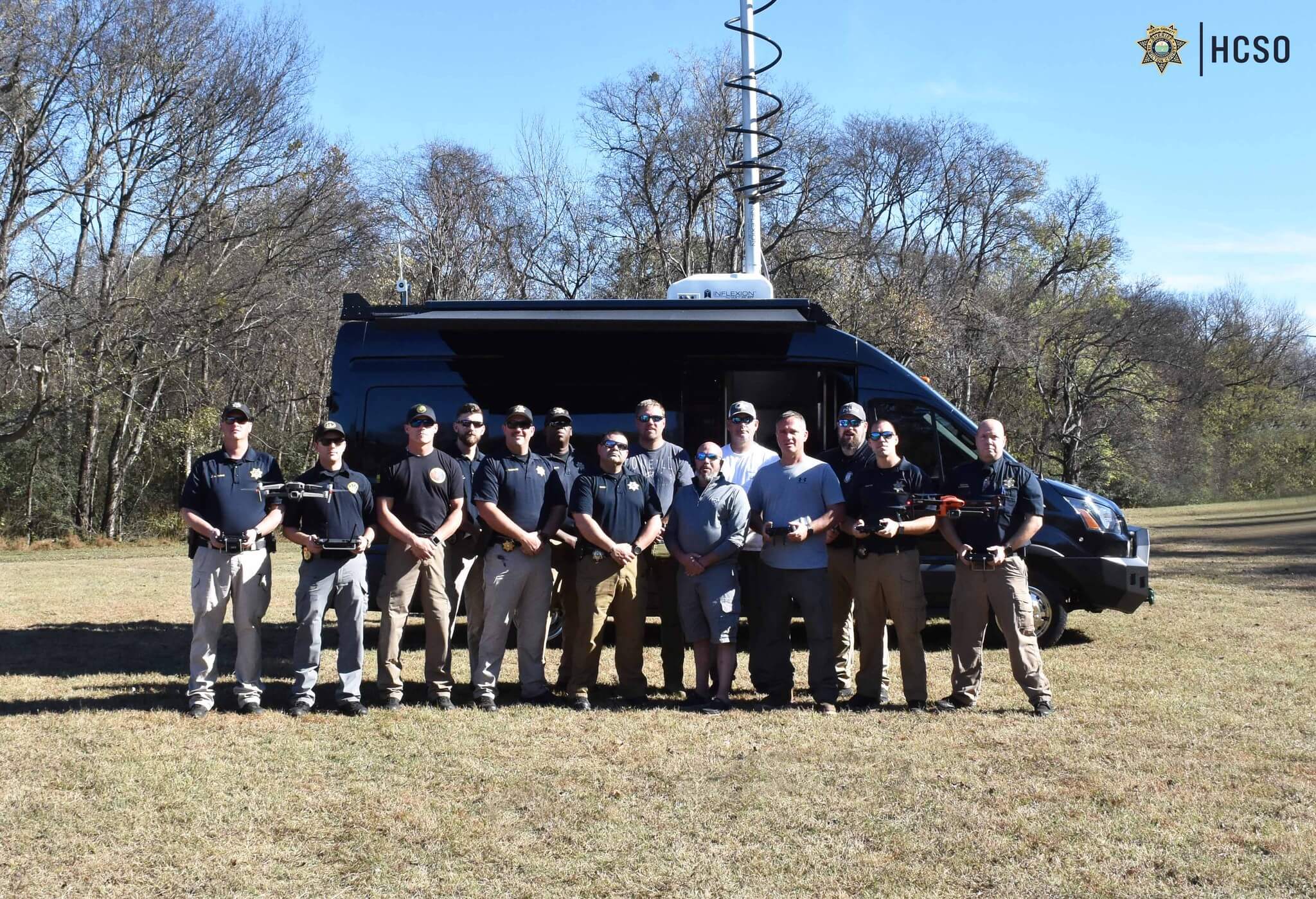
- Integrated Unmanned Aircraft Systems (UAS): Pilot-guided or autonomous drone operations perform aerial sweeps of perimeters, even at high altitudes. A drone scans acres far faster than your security personnel can do on foot.
- Rapid Deployment: Mobile command units bring the command center to the site, enabling rapid deployment. It has technology such as PTZ optical and thermal cameras, live streaming/broadcasting, and emergency lights and sirens to prevent deployment delays.
- Unified Video Surveillance and Analytics: Streams high-definition footage, thermal imaging, and AI-driven motion detection from all remote sites directly to central dispatchers.
Running an Effective Multi-Site Security Operation
Effective multi-site security operations start with the right physical command environment. You need one that is flexible, rugged, and equipped with reliable, essential technology.
Draxxon offers three levels of custom-engineered command platforms, each easily customized to match your specific needs for multi-site security operations.
Mobile Command Vehicles (DX-1000 Series)
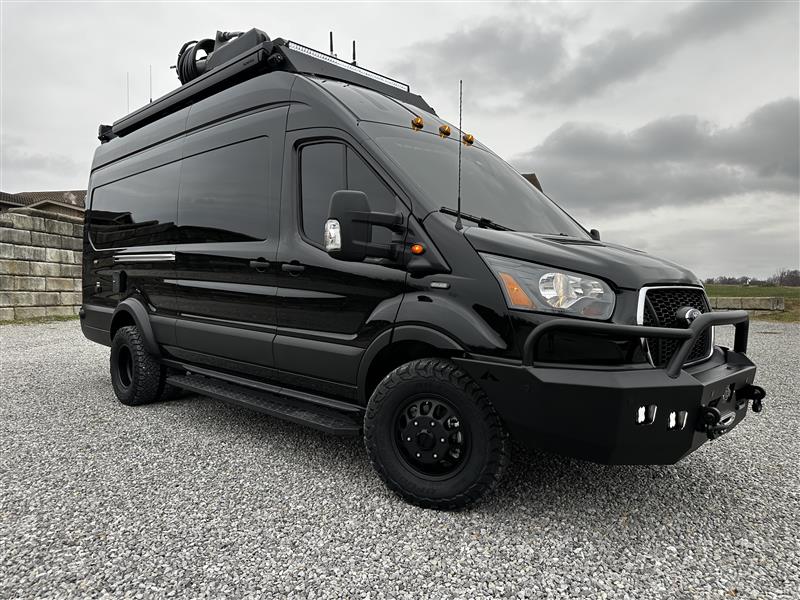
The DX-1000 series is built on the Ford Transit or Mercedes-Benz Sprinter platforms, both of which offer available off-road capabilities. As they can go most anywhere, they’re a mobile control center with:
- All-terrain mobility for rapid deployments to remote locations, construction sites, or unusual terrain like a field or rocky beach.
- Multiple workstation layouts with ergonomic setups, whiteboard walls and counters, and multi-feed video walls.
- Seamless tech integration to make it easy to connect with your existing access control systems and camera networks.
Mobile Command Trailers and Towables (DX-816 Platforms)
When you have security operations that require you to be in the area for days or weeks, Draxxon’s custom towables—such as the DX-816 system provide the space and features you need.
- Choose a fully electric option for silent, continuous operation, powered by electricity or a zero-emission battery charged by solar panels.
- Multiple trailer sizes enable you to choose the space you need for advanced server racks, central dispatch controls, and communications technology.
Portable Ground Control Stations (GCS)
Sometimes, you need to be on the ground. A GCS is completely portable and enclosed in a durable Pelican case. The GCS has:
- Monitors that are daylight viewable and make it easy to view UAS streams, site maps, and thermal imaging without having to go into a tent or shady area.
- Fits easily into a truck and isn’t too heavy to carry long distances if you have to travel to reach the incident area.
Other Areas of Consideration
Don’t overlook the value of integrated aerial reconnaissance and counter-UAS. As drone usage increases, it increases the risk of privacy intrusion and aerial threats. A multi-site security plan needs to include airspace awareness.
Draxxon platforms pair UAS (Unmanned Aircraft Systems) flight management with Counter-UAS (C-UAS) detection tools. Monitor and identify unauthorized aerial drones around or in the perimeters you’re safeguarding. Have defensive protocols in place in case of a breach or attack.
Improve Your Agency’s Multi-Site Defense Strategy
Delayed responses or gaps in your security protocols damage your reputation and can leave campuses, gated communities, or large facilities at risk. Make sure your monitoring operations include a private security command center that provides rapid threat detection, seamless communication, and continuous oversight.
Don’t leave your multi-site security to chance. Partner with the industry leaders in custom mobile command technology. Visit Draxxon‘s website today to speak with a mobile command specialist, explore custom vehicle configurations, and design a turnkey security command solution engineered for your exact operational requirements.